What Your Town Should Demand Before Approving a Data Center
Data centers are showing up on your electricity bill and in your zoning hearings. Here is what actually protects residents and ratepayers, and how to make it stick.
In Upper Merion, Pennsylvania, MLP Ventures has proposed a cluster of data centers that would generate enormous amounts of power on site, using a stack of approaches new to the region. The sound systems and other mitigation measures are not fully proven at this scale. The power plan rests on an arrangement with PECO, still in early discussions, under which the facilities would generate their own power at peak times and draw from the grid the rest of the time. That is a new concept for the utility, and its effects on rates and reliability are unknown. When residents ask how all of it will work, the answer reduces to: trust us that it will work out. That gap, between what is promised at a planning meeting and what can be verified and enforced, is the whole fight in miniature.
It is not only a fight for the people who live next door. The cost is now showing up on everyone's electricity bill. Data centers drove the majority of the most recent jump in regional power prices, and households across the grid that serves 67 million people from the mid-Atlantic to the Midwest are on track, by the Natural Resources Defense Council's estimate, to pay roughly seventy dollars more a month by 2028 for a buildout they did not ask for. The backlash is bipartisan, and the White House now says the technology companies should pay their own way. The same fight is unfolding in hundreds of towns, from Northern Virginia, which hosts a large share of the world's data centers, to Ohio, Texas, and beyond. If you are reading this because a project has been proposed near you, or because your power bill keeps climbing, the question that matters is what to demand and how to make the promises binding.
The argument. A data center should carry the full cost of the externalities it creates, from noise to grid strain, instead of pushing them onto neighbors and ratepayers. On everything a neighbor experiences at the property line, the facility should be indistinguishable from an office park, with power treated separately, because power is the one cost the office-park comparison cannot absorb. And every promise should become a covenant on the land, backed by independent public verification and a funded remedy that costs the developer more than the violation.
Key Points:
- Require conditional-use review, so the township can attach conditions and deny a bad application, instead of approving it by right under rules written for warehouses.
- Set a noise limit at the property line, not discernible above the existing background, verified by an independent monitor whose readings are public.
- Require a closed-loop water system with metered, published water use.
- Replace the token fine with a funded remediation escrow that pays an independent contractor to fix violations the developer does not cure.
- Get a bounded property-value guarantee with a buy-out option for the closest homes.
- Demand full power disclosure and a guarantee that residents' electric rates do not rise to subsidize the project.
- Tie community benefits to a binding agreement, traded for a zoning bonus the developer wants, because a township usually cannot simply require a payment.
- Allow no tax abatement, and push for county-wide standards so the project cannot shop for a weaker town next door.
None of this is anti-development. A developer that accepts these terms gets something it badly wants in the current climate: a faster and more predictable approval, far fewer appeals, and a real social license instead of a year of hostile hearings. In some communities, especially rural ones with a shrinking tax base, the project is genuinely wanted, and the same list still applies, because it makes sure a welcome project is also a fair one. The demand list is the opening position in a negotiation that can work for both sides.
Disclosure, since this piece argues for disclosure: I live in the area. I work for Accenture, and the opinions here are solely my own. Accenture does some work with data centers; I personally do not perform any work related to data centers.
The rest of this explains why each of these matters, and why a developer's goodwill will not deliver any of them on its own. I'll start with the two fights I have followed closely.
In East Whiteland Township, Chester County, a data center on the former Foote Mineral Superfund site sits across the road from the Malvern Hunt neighborhood. The developers, Green Fig and Sentinel Data Centers, won planning approval in 2024 for a roughly one-million-square-foot facility, on a site already zoned for as much as 1.86 million.
Early in 2026 they sought to amend the plan upward by about 61 percent, to more than 1.6 million square feet. After months of opposition that included protests and halted meetings, they floated a smaller, single-story version of about 887,000 square feet.
Then in May they reversed course again, telling the township that rather than wait for approval of an amended plan, they would build the larger version they were already entitled to. Sentinel CEO Josh Rabina put the leverage plainly, calling the approved plan less efficient but vested and profitable: "This is not bluffing."
In Upper Merion, Montgomery County, MLP Ventures and its founder, Brian O'Neill, have filed a cluster of projects at five sites totaling more than 4.6 million square feet, nearly twice the floor area of the King of Prussia Mall.
The proposals drew a petition with more than ten thousand signatures, a hearing that overflowed onto the lawn, and a planning commission meeting in late May that drew more than a thousand residents. They were submitted roughly ten days before the township's new data center ordinance took effect, and the township says state law requires reviewing them under the prior, looser rules.
I am not opposed to data centers. The computing they house is genuinely useful, and the infrastructure has to be built somewhere. Importance is a reason to build these facilities well. It does not settle the terms on which a community should agree to host one. That is the question these two cases raise.
The leverage is not developer goodwill
Both cases share a feature worth naming up front. By the time residents are in the room, most of the leverage is already gone. East Whiteland's project is approved, and the dispute is over an expansion that the developer can drop while still building at scale. Upper Merion's projects beat the new ordinance to the filing window. Developers, reasonably, point out that they are code-compliant and need no variances.
To be fair to the East Whiteland developers, they did volunteer constraints. The 887,000-square-foot single-story version, with reduced height and improved landscaping, was a real concession, offered to quiet the backlash. It did not quiet it, and in May they withdrew the concession and reverted to the larger plan they were entitled to build. Rabina's statement captured the leverage underneath the exchange: approve the plan we prefer, or we build the larger one you like less. The episode makes the structural point better than any argument could. A volunteered concession lasts exactly as long as it is useful to the developer. It binds nothing, and when it stopped buying peace, it was withdrawn. Code compliance sets a minimum standard for construction. Whether a project has accounted for its costs is a separate question, and the code does not answer it. Good outcomes depend on the terms written into ordinances and agreements before approval is granted.
Why the defense falls to local government
Anyone expecting Harrisburg to handle this should read the fine print. Governor Josh Shapiro has been consistently pro-development on data centers, attracting tens of billions in private investment and appearing at the site of a future Amazon data center in Bucks County. In late May he released the full Governor's Responsible Infrastructure Development (GRID) Standards, presented as guardrails covering energy affordability, community engagement, workforce, and the environment.
Credit where it is due. The standards take the affordability problem seriously, and requiring a developer to bring its own power is the right core idea. The structure is what limits them. GRID standards are conditions a developer must meet to receive state support, including tax incentives and expedited permitting through the Office of Transformation and Opportunity. They function as a gate to state benefits. A project that does not seek those benefits is not bound by them, which leaves the developers most able to self-finance the least constrained. On the local impacts that fill these auditoriums, including noise, property value, water, and viewshed, GRID sets expectations for projects seeking state help and stops short of enforceable limits that apply to every project.
The administration was explicit about where the rest of the work goes. Alongside GRID it released a toolkit to help municipalities navigate proposals on zoning, infrastructure capacity, fiscal impact, and community benefits. The message to townships is that the state will compete for these projects and local officials should work out the terms. State policy sets the competitive backdrop. The enforceable protections come from the township, which is the same conclusion the East Whiteland and Upper Merion timelines point to.
The principle: a project should carry its own costs
The standard worth applying is the ordinary economic one. A data center should bear the full cost of the externalities it creates. Costs currently pushed onto neighbors, including noise, water use, grid strain, and depressed home values, should be carried by the party generating them. A project that can carry those costs proceeds. A project that cannot does not get built in that location. That outcome is the principle working as intended.
This is not a fringe position. Economists have made the same argument directly, that an industry should internalize and pay the real costs of its deployment rather than be singled out for either subsidy or prohibition. It keeps the focus where it belongs, on terms and compensation rather than on a yes-or-no verdict that the zoning code has often already decided.
The benchmark: an office park, plus disclosed power
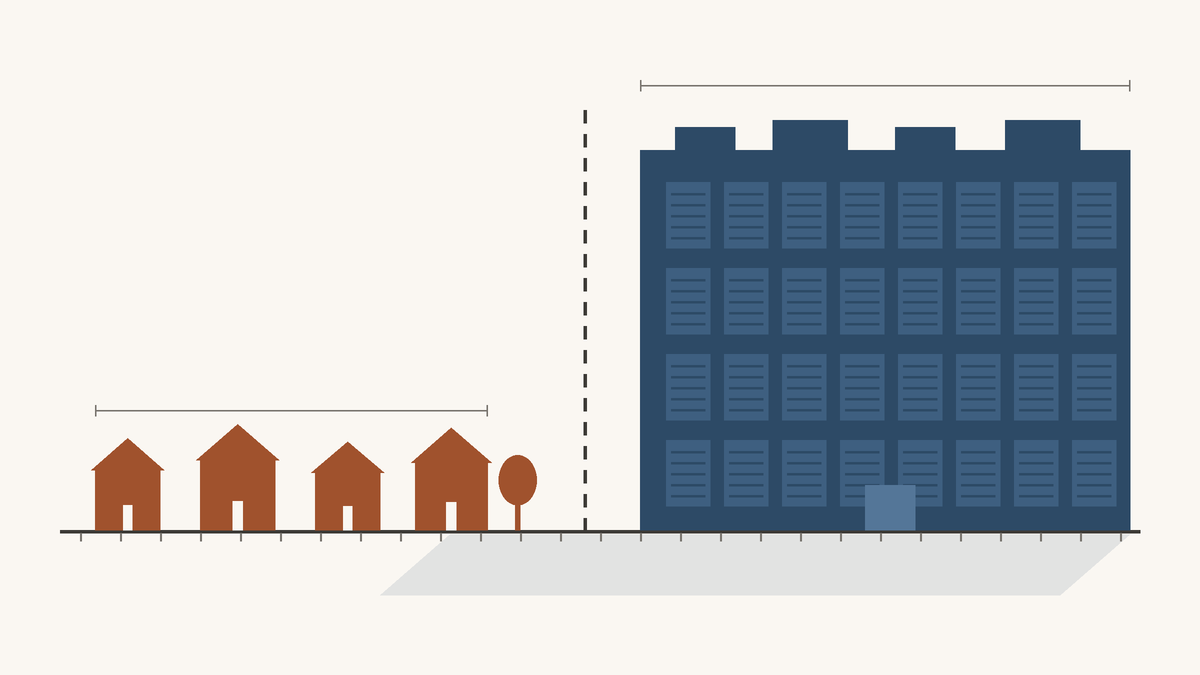
A workable test for what residents are owed is that a data center should be indistinguishable from an office park on everything a neighbor experiences at the property line. Noise, light, traffic, water use, and odor should all be office-grade or better.
The one thing the analogy cannot absorb is power. An office park does not draw 900 megawatts, the figure the developer cited in Upper Merion, which he said is enough to power roughly a million homes. Power is the category that is genuinely different, and it has to be disclosed and addressed on its own terms. Upper Merion shows why. The proposal's power plan is a hybrid: on-site generation at peak times, grid power the rest of the time, under an arrangement with PECO that is still in early discussions. PECO has not operated under this model before. Whether it protects other customers' rates or quietly shifts costs onto them cannot be known yet, and a claim that cannot be evaluated yet is precisely the kind that needs binding terms and verification rather than confidence. A developer who uses the office-park comparison to wave off the grid question is signaling which question is the hard one. It is also the cost that lands on everyone else, in the form of the rising bills now driving a national backlash. The clean rule is the one gaining bipartisan support: a project this size should bring its own power, new generation or contracted capacity, so the regional grid and its existing customers are not quietly subsidizing it.
The mechanism: guarantees, remediation, verification
A promise made at a planning meeting carries no weight without three things attached to it: a measurable standard, a way for residents to verify it, and a remedy that costs the developer more than the violation.
On remedies, the current tools are weak. Most municipal noise ordinances were written for nuisances like loud parties, not continuous industrial sources, so complaints tend to go nowhere. Where penalties do exist, they are often trivial against the economics of the facility. East Whiteland's nuisance ordinance caps the fine at $1,000 per violation, with each day past the abatement deadline counted as a separate offense. Run continuously, that comes to at most $365,000 a year. For a project of this scale that is a rounding error, and a developer can budget for it in advance. When the penalty costs less than fixing the problem, it stops being a deterrent and becomes one more line in the operating budget.
Three mechanisms change that:
- Promises become covenants on the land. Every planning-stage claim, including a noise ceiling, a closed-loop water system, and limits on generator runtime, is recorded as a covenant that runs with the property. It binds today's developer and whoever owns the site in ten years, which matters because the operator who makes the promises is rarely the one who keeps them.
- A funded remediation escrow that replaces the recurring fine. The developer posts a replenishing surety or letter of credit, the same instrument mining and landfill operators use to guarantee cleanup. If a violation goes uncured past a set window, an independent administrator draws on it to hire a contractor to fix the specific problem at the developer's expense, with penalties that escalate steeply for repeat violations and a full operating halt reserved for the rare case where abatement fails. This keeps the teeth while staying financeable, because lenders can price a known escalating cost and a guaranteed fix even though they cannot price a discretionary shutdown.
- Verification is independent, public, and continuous. Property-line sensors for noise and air quality report to a public dashboard, operated by a third party and paid for by the developer, measured against a pre-construction baseline. Claims become checkable in real time instead of litigated after the fact.
Applied across the full set of impacts, the framework looks like this:
| Impact | Standard | Verification | Remedy |
|---|---|---|---|
| Noise | Not discernible above ambient at the property line | Public real-time monitor vs. baseline | Escrow-funded abatement; escalating penalty |
| Water | Closed-loop; zero net draw from the local table | Metered, published figures | Penalty scaling with overdraw |
| Air / emissions | Defined ceiling; no continuous generator runtime | Stack and ambient monitoring | Halt on exceedance |
| Power / grid | Brings its own power; no net rate increase passed to residents | Utility filings; rate audit | Bill offset to the impact zone |
| Light | Dark-sky compliant | Photometric survey | Retrofit at developer cost |
| Property value | No loss vs. certified pre-construction baseline | Independent appraisal | Bounded guarantee; buy-out option |
| Construction | Bounded hours; traffic management plan | Township inspection | Standard penalties |
The table forces a developer to attach a number and a consequence to every line. It prevents the common pattern of answering the easy categories, such as light and water, while deflecting the hard ones, such as power and property value.
The harder problem: what does the community actually get?
Even a perfectly mitigated data center raises a fairness question that the industry tends to skip. These facilities employ very few people once built. The construction jobs are real but temporary, which is why the building trades show up in support and the neighbors do not. The standing economic case is tax revenue. In Upper Merion, the developer projected a 54 percent increase in township property tax revenue and a 28 percent increase for the school district, and claimed the project would generate ten times the jobs of the Comcast tower's construction.
Take the developer's figures at face value and the added revenue would be meaningful to a township budget and its schools, though Upper Merion's own tax collector disputed them at the hearing. Either way, the structural issue is distributional. The benefit is diffuse and accrues to the township as a whole, while the cost is concentrated on the homes nearest the site. The people who lose quiet, viewshed, and possibly home value are not the people who see the tax line improve.
If a data center is going to carry its full costs, that mismatch is one of them. Several mechanisms address it directly:
- A host-community fee. Landfills, casinos, pipelines, and power plants already pay host communities for being regionally useful but locally undesirable. A data center belongs in that category and should be treated the same way, which applies an existing principle consistently across a class of land use.
- A bounded property-value guarantee with a buy-out option. Programs near airports and landfills already work this way. Each home in the radius gets a certified pre-construction appraisal, and if the owner sells within a set window for less than that baseline adjusted for the market, the developer pays the difference up to a per-home cap. Only homes that actually sell trigger it, which dates and caps the liability and makes it insurable. For the nearest ring, owners get the option to sell to the developer at pre-development value plus an uplift. Tying payment to a measured trigger avoids the usual fight over what caused a price to move.
- A resident dividend or utility offset. A per-megawatt annual payment funding electric-bill credits for nearby homes turns the power draw into a local benefit and answers the fear that the facility will raise local rates.
- Backup power and waste heat as amenities. On-site generation can be structured to island the adjacent neighborhood during outages, turning the feared turbines into a resilience asset. The facility's waste heat, normally vented, can feed a district-energy loop for municipal buildings, a recreation center, or greenhouses, as data centers in northern Europe already do.
- A workforce and education pipeline. Because the permanent jobs are few, the durable local benefit is human capital: funded apprenticeships with the building trades, a community-college training track, and a computing curriculum in local schools.
- No tax abatement. If the case for the project is tax revenue, the revenue has to be real. Approval should be conditioned on full assessed valuation.
How this would actually happen
The framework above is not self-executing, and Pennsylvania law shapes what is possible. A scope note first: I am not a lawyer and nothing here is legal advice. What follows is a summary drawn from the public documents listed at the end of this piece, principally the Municipalities Planning Code and the joint county ordinance guide, and any township acting on it should put the actual drafting in front of its solicitor.
Municipalities hold only the powers the state grants them, and their authority over land use comes from the Municipalities Planning Code rather than from general police power. Two consequences follow.
A township cannot simply ban data centers. Pennsylvania courts, applying the Planning Code, require municipalities to permit every lawful use somewhere within their borders, and the county guide warns that an outright ban would likely be struck down as exclusionary, which could then let a developer build the use almost anywhere in the township with few constraints. That leaves regulation as the available tool, and townships have to use it well.
The most consequential decision a township makes is whether data centers are permitted by right or as a conditional use. A by-right use can be held only to the standards already in the code, which in most townships were written for ordinary industrial buildings. A conditional use requires the developer to appear before officials at a public hearing, meet defined standards, and accept conditions, and it lets the township deny an application that falls short. This is why municipalities across Pennsylvania, including ones now fighting projects in Chester and Lackawanna counties, are moving data centers into the conditional-use category. East Whiteland itself began revising its data center zoning ordinance in April, under the public pressure described above. It is also why the Chester County and Montgomery County planning commissions jointly published a data center ordinance guide in April that recommends exactly that approach, with model language for facilities over 100,000 square feet. A township does not have to draft from scratch. Detailed templates from the counties and from groups like PennFuture are available to adapt.
Adopting that standard in common matters as much as the standard itself. When the municipalities in a county move together, and the county model ordinances make this practical, a developer can no longer play one township against the next. The broader worry, that strict rules send the project to another state, is weaker than it sounds, because what determines where a data center can physically go is power, fiber, and latency, not local noise limits. Standards that travel across a region close the local loophole without touching the things that actually drive siting.
Within a conditional-use ordinance, most of the framework is enforceable as a condition of approval: setbacks and buffers from homes, schools, and daycares; height limits; required noise, vibration, water, and traffic studies with binding limits; generator emission standards; proof of utility capacity; continuous monitoring; and financial security for the improvements. Recording these conditions as covenants that run with the land, and requiring the verification described earlier, fits squarely within this authority.
The compensation tools are the hard part. Proposals for community benefit agreements and revenue-sharing funds are now common in the national conversation, including ones that would route a small share of a data center's revenue into a community fund. The question those proposals usually skip is whether a municipality can require them. In Pennsylvania it largely cannot. Host fees, make-whole funds, and resident dividends are the items a township most likely cannot impose, because Pennsylvania statute limits municipal impact fees and compelled payments of this kind risk being struck down as unlawful exactions. The Montgomery County guide is explicit that a community benefit agreement should not be written into an ordinance, that a municipality cannot compel a developer to enter one, and that officials should keep their distance so the agreement is not deemed an unlawful exaction. The compensation pieces therefore have to arrive through one of two routes: a voluntary community benefit agreement negotiated between the developer and a residents' group, or a change in state policy that attaches money to compliance, such as conditioning the data center sales-tax exemption on GRID certification.
There is a lawful way to make those agreements actually happen, borrowed from how communities have funded affordable housing for decades. Incentive zoning sets a strict baseline and then offers the developer something it wants, such as additional buildable area, height, or genuinely faster review, in exchange for a community benefit agreement. Because the developer opts into an optional bonus, the benefit becomes a negotiated trade rather than a compelled payment, which is how density bonuses survive the same legal test that blocks exactions. Pennsylvania's authority for this is narrower than in some states and the structure has to be drafted carefully, but the principle is sound: it turns the leverage problem into a transaction and gives a developer a concrete reason to sign rather than a request to be generous. The cleaner long-term fix sits at the state level: the legislature could authorize a data center host fee the way it once narrowly authorized transportation impact fees. If compelled payments are barred, the honest answer is to change the statute.
There is also a clock, and the drift in Harrisburg is toward speed. One measure, the proposed Artificial Intelligence and Data Center Act, would impose zoning and shot-clock mandates that limit how long a municipality can take to act. A separate bill backed by Governor Shapiro, which has already passed the state House, would push a model ordinance meant to standardize and speed local review, though municipalities would not be required to adopt it. A third would require the state to decide environmental permits within 120 days for large data centers that bring their own power. Combined with the rule that a pending application is generally judged under the ordinance in effect when it was filed, the lesson is the one Upper Merion learned: an ordinance written after the application lands does not bind it. The window for local action is open now, and it may not stay open.
The case for developers to get on board, and why it is thin
For the regulable items, "voluntary" is the wrong word. Noise limits, buffers, monitoring, and bonds are conditions of approval under a conditional-use ordinance, so they require no goodwill. A developer that wants the approval meets them.
The cash compensation is where the question bites, and the honest answer is that the business case for volunteering is weak. A developer accountable to investors gives money away only when keeping it costs more. Three situations produce that result.
The first is credible opposition. Organized residents who can file appeals and prolong hearings impose real cost in time and capital, and time is the expensive input for these projects. Where opposition can plausibly delay a project by a year, a community benefit agreement becomes the cheaper path to a schedule and to social license. This is the practical reason the crowded meetings in East Whiteland and Upper Merion matter even when a project is already approved. They are the leverage residents retain after the entitlement is granted, and they are what can make a voluntary agreement worth more to the developer than the cash it costs.
The second is a state incentive with a price attached. If Pennsylvania conditions the data center tax exemption, projected to exceed half a billion dollars a year by the end of the decade, on certified community benefits, then compliance carries a clear dollar value. As GRID is currently structured, on an opt-in basis, that lever is weak, and a developer that does not need the exemption can ignore it.
The third is reputation, which rarely moves capital on its own.
Outside those three situations, a profit-maximizing developer has little reason to volunteer, and expecting otherwise is not a plan. That is the core of the matter. The protections residents can count on are the ones a township writes into a conditional-use ordinance before an application arrives, backed by verification and bonds. Compensation beyond that depends on leverage, from organized opposition or from state law. A developer's willingness to be generous is not something to count on.
What the developers will say
A serious proposal should anticipate the responses. The likely ones, and the answers:
- "We are code-compliant and need no variances." Compliance is the floor. These mechanisms work through conditions, agreements, and updated ordinances, which is exactly why the Upper Merion filing timed ten days ahead of the new rules matters so much.
- "We will build the larger approved version instead." East Whiteland stated this position outright. Fix the terms at the zoning and entitlement stage, and attach covenants and host obligations to the entitlement itself, so the fallback plan carries the same conditions.
- "These conditions make the project uneconomic." If a project cannot carry its own costs, screening it out is the intended function. Neighboring jurisdictions adopting similar standards reduces the pressure to compete by lowering protections.
- "We already mitigate, with closed-loop water, dark-sky lighting, and noise monitoring." Then binding verification and remedies cost nothing to accept, because a real mitigation is one a developer can guarantee. In Upper Merion, the sound mitigation and the peak-only power arrangement are new approaches, not fully proven at this scale, which is the precise reason claims need independent confirmation rather than trust. An unproven system may well work. The neighbors should not be the test bed for finding out without a remedy attached.
- "The benefits are jobs and tax revenue." The jobs are mostly temporary construction work. The tax revenue is real only without abatement, and it should be shared with the impact zone that bears the cost.
What the framework cannot do
Three honest limits, because a serious argument states them.
First, full compensation can price a project out. If the cost of the externalities is high enough that no package makes the math work, the project should not be built in that location. That outcome is the market reaching the right answer.
Second, the pricing can err in both directions, and a framework that only polices underpayment becomes a polite instrument of exclusion. Every mechanism in this piece guards against a developer paying too little. A township can also demand too much, stacking the full list against a marginal project not because the impacts justify it but because the leverage allows it. The discipline that prevents this is the same one demanded of developers: attach a number and a justification to every line. The non-negotiables are the standards that protect health and safety, with verification and a funded remedy, because those are the project's actual costs. The compensation layers, including the size of a host fee, the scope of a value guarantee, and any dividend, should scale with documented impact, not with bargaining position. A town that cannot say which of its demands it would drop for a well-mitigated project is not internalizing externalities. It is rent-seeking with better vocabulary.
Third, money does not make everyone whole. A parent who does not want gas turbines beside an elementary school is not satisfied by a dividend check. Internalizing externalities handles the harms that can be measured and paid for. It does not resolve the siting fights that turn on things no one can price, and it should not pretend to.
A pause is not the destination
Some communities are reaching for a moratorium instead, and several in Pennsylvania have. That is an understandable response, and a pause can be the right move when an ordinance is not yet written. But a moratorium is blunt, temporary, and now exposed to the same state preemption that threatens local zoning. A durable conditional-use and incentive-zoning regime is what a pause is meant to buy time to build. The framework here is the permanent version of what a moratorium reaches for.
Trust is built by structure
There is a reason these meetings curdle. Residents are asked to take descriptions of new and unproven systems on faith, and the tools available to hold a developer to its word are thin. The path forward is to make the claims checkable: independent peer review of the noise and emissions models, published in plain language; a township-retained expert, paid for by the developer but answering to the public; and a reference facility residents can visit and measure, so a promise to spend millions on noise abatement becomes an invitation to measure an identical unit already running elsewhere.
Data centers say they want to be good neighbors. They can demonstrate it by accepting the standards, the verification, and the remedies that make trust unnecessary, and by paying for the costs the community would otherwise absorb on the project's behalf. A developer willing to do that will find the auditoriums a great deal quieter.
The two townships here are early. Hundreds of these decisions are queued across the country, and the ones that go well will be the ones where the terms were settled before the bulldozers arrived. Goodwill is not a mechanism, and a town that waits for it will get neither the protections nor the payments.
Sources and further reading
The two local fights
- East Whiteland Township, Sentinel/Green Fig data center project page
- Philadelphia Inquirer coverage of East Whiteland: expansion proposal (Jan. 2026), overflow meeting (Feb. 2026), planning commission hearing (Mar. 2026), zoning ordinance revision (Apr. 2026), reversion to approved plan (May 2026)
- Philadelphia Inquirer, Upper Merion data center cluster proposal (May 2026); CBS Philadelphia and NBC10 coverage of the public meetings
Law and ordinances
- Pennsylvania Municipalities Planning Code, Act 247 of 1968, as amended
- East Whiteland Township Code, Chapter 133, Article II, Noise and Nuisances (fine structure at § 133-9)
- Chester County and Montgomery County Planning Commissions, Data Center Ordinance Guide (April 2026)
- PennFuture model ordinance resources for municipalities
State policy
- Governor's Responsible Infrastructure Development (GRID) Standards and municipal toolkit, Commonwealth of Pennsylvania (May 2026)
- Computer Data Center Equipment Exemption Program, Act 25 of 2021; Pennsylvania Independent Fiscal Office estimates of the exemption's cost
Power costs and the regional grid
- PJM Interconnection, 2027/2028 Base Residual Auction results (Dec. 2025)
- PJM Independent Market Monitor data-center cost attribution, via Utility Dive
- Natural Resources Defense Council, analysis of PJM capacity costs and household bill impacts
Compensation precedents
- Brookings Institution work on data centers and rural communities (decommissioning bonds, escrow accounts, performance milestones)
- Town of Brookhaven, N.Y., host community agreement (2023), a $168.9 million precedent for host fees
AI assisted in the creation of this article, but the ideas are my own.